
Ingredients
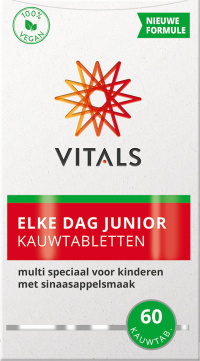
| Product name: | Vitals Elke Dag Junior |
| Content: | 60 chewable tablets |
| For whom: | Children, Vegan Supplements |
Supplement Facts per chewable tablet (Serving Size)
| Amount | IE/IU ‡ | RI † | |
| Beta carotene (Dunaliella salina) | 0,6 mg | 1000 IE | |
| - Vitamin A | 100 mcg RE | 333 IE | 13% |
| Vitamin A (retinyl acetate) | 100 mcg | 333 IE | 13% |
| Vitamin B1 (thiamine HCl) | 0,55 mg | 50% | |
| Vitamin B2 (riboflavin-5-phosphate sodium) | 0,7 mg | 50% | |
| Vitamin B3 (niacinamide) | 8 mg | 50% | |
| Vitamin B5 (calcium D-pantothenate) | 3 mg | 50% | |
| Vitamin B6 (pyridoxal-5-phosphate) | 0,7 mg | 50% | |
| Folate (5-MTHF glucosamine salt) (Quatrefolic®) | 100 mcg | 50% | |
| Vitamin B12 (50% methyl, 50% adenosylcobalamin) | 5 mcg | 200% | |
| Biotin (D-biotin) | 25 mcg | 50% | |
| Choline (Choline Bitartrate) (VitaCholine®) | 50 mg | ||
| Vitamin C (Ascorbic Acid) | 80 mg | 100% | |
| Vitamin D3 (cholecalciferol) (vegetable) (Vitamin D3V®) | 15 mcg | 600 IE | 300% |
| Vitamin E (D-alpha-beta-gamma-delta tocotrienol) | 10 mg TE | 15 IE | 83% |
| Mixed Tocopherols (Beta, Gamma, Delta) | 5 mg | 7 IE | 42% |
| - converted to vitamin E | 2 mg TE | ||
| Vitamin K1 (phytomenadione) | 22,5 mcg | 30% | |
| Vitamin K2 (menaquinone-7) (K2VITAL®DELTA) | 45 mcg | 60% | |
| Calcium (calcium carbonate) (from red algae) (Aquamin® Calcium) | 120 mg | 15% | |
| Iron (iron bisglycinate) (Ferrochel®, TRAACS®) | 2,1 mg | 15% | |
| Iodine (potassium iodide) | 37,5 mcg | 25% | |
| Magnesium (hydroxide) (Aquamin® Magnesium) (from sea water) | 60 mg | 16% | |
| Molybdenum (sodium molybdate) | 10 mcg | 20% | |
| Selenium (L-selenomethionine) | 13,8 mcg | 25% | |
| Zinc (zinc bisglycinate) (TRAACS®) | 1,5 mg | 15% | |
| Lutein (African Marigold Extract) (Tagetes erecta) | 2,5 mg | ||
| Zeaxanthin (African Marigold Extract) (Tagetes erecta) | 0,5 mg |
Ingredients Sweeteners (mannitol, xylitol and steviol glycosides from stevia [95% rebaudioside M]), minerals (calcium, magnesium, iron, zinc, molybdenum, selenium, iodine), vitamins (C, E, B3, D3, K2, B5, A, B6, B2, B1, K1, folate, biotin, B12), choline bitartrate, rapeseed oil (Brassica napus), natural orange flavouring, mixed tocopherols, beta-carotene, thickener (hydroxypropyl cellulose), lutein, anti-caking agents (magnesium salts of fatty acids, silicon dioxide), zeaxanthin.
Explanation of the composition
‡ IE/IU = International Units. IE/IUs are only used for vitamins A, D and E. The exact definition of 1 IE/IU varies per substance and is established in international agreements.
†RI stands for Reference Intake and replaces the RDA (Recommended Daily Allowance). RI is a guideline for the intake of vitamins and minerals in particular. RI and ADH are equal in number.
Usage advice
Suggested use
Chew one tablet per day during a meal.
Children 3 years and older chew 1 tablet daily with a meal or as advised. If your child still has difficulty chewing tablets, it is best to crush them and mix them into yogurt or porridge, for example.
Stick to the recommended daily dosage, unless advised otherwise.
A varied, balanced diet and a healthy lifestyle are important. Nutritional supplements are not a substitute for a varied diet.
If you have health issues or are taking medication, always consult your doctor before taking certain supplements. More usage advice.
Storage advice Store in a cool, dry and dark place. Not in the refrigerator.
Keep out of reach of children.
Best by date 60 chewable tablets: April 2028
Allergy information / Warnings
| Warnings |
| Recommended for children 3 years and older. This dietary supplement is not suitable for children under 1 year of age (legally required statement for products containing up to 3 mg vitamin B6 per daily dose). |
| With sweetener(s) |
| This supplement is: |
| Suitable for vegetarians |
| Suitable for vegans |
Daily support for children
Elke Dag Junior is an orange-flavoured chewable tablet in the shape of a small elephant. It is developed for children aged 3 and over.
The formula is based on recent scientific insights, current data on nutritional status in the Netherlands, and optimal intake levels per nutrient.
Elke Dag Junior stands out for its composition, dosage, and absorbability. It contains almost all the same high-quality nutrients as Elke Dag for adults, but in amounts adjusted to the needs of young children.
One tablet provides 15 μg vitamin D3, so separate vitamin D drops are no longer needed. It also contains 60 mg magnesium and 120 mg calcium from natural sources.
Which sweeteners?
A chewable tablet does, of course, need to taste good — otherwise children simply won’t want to take it. Sugar gives the best flavour, but it has been deliberately avoided due to its harmful effects on teeth. Developing a tasty, sugar-free multivitamin is quite a challenge. This is because many vitamins and minerals have a naturally bitter or metallic taste. Moreover, not all sugar substitutes are suitable.
Following extensive taste tests, Elke Dag Junior has opted for a combination of steviol glycosides derived from the stevia plant, xylitol and mannitol. Together with a natural orange flavouring, this creates a pleasant taste that is well accepted by children — without any added sugars.
B vitamins in active forms
The Elke Dag multis contain substantial but responsible amounts of B vitamins. Daily needs, average intake, lower limits, conversion in the body, scientific insights, and safe upper limits were all taken into account.
All formulas contain the biologically active forms of vitamin B2, B6, B12, and folate. Research shows that these forms have higher biological availability.
Vitamin B2 is included as riboflavin-5'-phosphate. Vitamin B6 is included as pyridoxal-5'-phosphate.
Vitamin B12 is included as methylcobalamin and adenosylcobalamin. Folate is included as 5-methyltetrahydrofolate glucosamine salt.
A relatively high dose of choline (VitaCholine®)
Choline has been a standard ingredient in multivitamins for many years, but usually in low doses (up to around 10 mg). At the time, this was mainly due to limited knowledge of choline’s physiological role and the recommended intake. Thanks to scientific research, much more is now known about this important nutrient.
Choline is a conditionally essential nutrient. This means that the body can produce it itself, but that this endogenous synthesis is insufficient to meet the full requirement. We are therefore dependent on our diet for an adequate intake. The main sources of choline are animal products, such as eggs and meat.
The European Food Safety Authority (EFSA) has set an adequate intake for children of 170 mg per day (4–6 years) and 250 mg per day (7–10 years). There are indications that a growing proportion of children are not meeting these levels, particularly in diets with a lower intake of animal products.
This provides a clear reason to include choline in an appropriate dose in a daily multivitamin for children. All ‘Elke Dag’ multivitamins use VitaCholine® for this purpose, a high-quality and well-researched source of choline.
Plant-based vitamin D3
European authorities have raised the level for adequate vitamin D intake from food to 15 µg and the maximum permitted level to 100 µg. In the Netherlands, advice is still more cautious, with 10 µg as sufficient and 75 µg as the maximum.
The reference intake has remained at 5 µg. At the same time, higher vitamin D dosages have long been valued in orthomolecular practice.
Leading vitamin D experts advise an adult calcidiol level of at least 75 nmol/l. An oral dose of 25 to 75 µg vitamin D3 per day is estimated to help maintain that level.
The Elke Dag multis contain substantial amounts of patented vitamin D3, which is more effective than vitamin D2 at raising vitamin D levels.
Suitable for vegans
The new Elke Dag multis use plant-based vitamin D3, Vitamin D3V®, produced from algae rather than sheep's wool grease.
That means all multis in the Elke Dag range are also suitable for vegans.
Elke Dag Junior provides 15 μg vitamin D3 per tablet.
Vitamin K1 and K2
The Elke Dag multis now also contain a small amount of vitamin K1, alongside a higher dosage of vitamin K2.
Vitamin K1 is absorbed mainly by the liver and mainly supports activation of clotting factors. Vitamin K2 has higher biological availability, is distributed more widely through body tissues, and is more effective in activating proteins such as osteocalcin and MGP.
These proteins help calcium be absorbed properly and reach the right place in the body, namely the bones.
The body always uses vitamin K first for the vital blood-clotting function. Because vitamin K2 is a much more expensive raw material than vitamin K1, a small amount of K1 is added for that priority function.
Why both forms are used
This allows vitamin K2 to be used for other important functions. The current reference intake for vitamin K is based only on the amount needed for normal blood clotting.
It does not reflect the optimal dosage for other vitamin K-dependent processes in the body.
Stable vitamin K2
Vitamin K2 is a very sensitive substance. In combination with calcium or magnesium, its level in a tablet or capsule can drop sharply.
That makes vitamin K2 technically difficult to use in products with high amounts of these minerals. Vitals therefore uses K2VITAL™ DELTA, which remains stable even in formulas rich in calcium and magnesium.
This ingredient is made with a patented microencapsulation process. Two protective layers shield the fat-soluble K2 particles from interaction with other ingredients.
Vitals had K2VITAL™ DELTA tested in an independent laboratory against other vitamin K2 brands in combination with the ingredients used in Vitals products.
Tested for stability
The conclusions were clear. Protection of vitamin K2 was necessary, the K2 level remained stable with K2VITAL™ DELTA, and this ingredient performed better than the other K2 ingredients tested.
Calcium and magnesium from the sea
The multis use calcium and magnesium from Aquamin®, sourced from the sea. This makes it possible to include much higher dosages than with earlier compounds, while absorption remains proven to be good.
Aquamin Magnesium comes from seawater from the Irish Sea. Studies show that it is well absorbed in the body.
Besides about 35% elemental magnesium, this raw material also contains small amounts of other minerals and trace elements.
Aquamin Calcium comes from a red algae called Lithothamnion calcareum. This algae absorbs minerals and trace elements from the sea and stores them.
Natural mineral profile
When alive, it has a red-pink colour. After it dies, it calcifies and turns white or light grey. Only calcified red algae are harvested, from waters near the coast of Iceland.
Besides 32% calcium, this raw material also contains 3% magnesium and small amounts of other minerals and trace elements.
The natural trace element profile of this calcium and magnesium may partly explain the strong absorption and the positive study results.
Chelated minerals
Iron, zinc, copper, and manganese are included as amino acid chelates, or bisglycinates. In this form, each mineral particle is strongly bound to two glycine molecules.
Minerals in this form reach the small intestine well, are absorbed very effectively, and are gentle on the stomach. That is especially useful in the case of iron.
Vitals specifically uses Albion Minerals amino acid chelates, identified by the TRAACS® trademark, which stands for The Real Amino Acid Chelate System.
This brand was created to distinguish these chelates from other amino acid chelates that may be inferior or unstable. Albion holds more than 100 patents worldwide for the process, science, and structure of its chelated minerals.
Lutein and zeaxanthin
Lutein and zeaxanthin are natural carotenoids. The body contains high concentrations of these substances in the retina and macula.
The body cannot make lutein and zeaxanthin itself, so they must come from food. They are found in green leafy vegetables and in red, yellow, and orange fruits and vegetables.
Need expert advice?

Would you like to know more about this product or receive personalized advice from our orthomolecular therapist, Liesbeth?
Then please use our consultation form
Our consultations are free of charge.
Patented ingredients

Aquamin® is a registered trademark of Marigot Ltd.

Ferrochel® is a registered trademark of Albion Minerals, Balchem Corporation (US).

K2VITAL® DELTA is a registered trademark of Kappa Bioscience.

Quatrefolic® is a patented product and a registered trademark of Gnosis.

TRAACS™ (The Real Amino Acid Chelate System) is a registered trademark of Albion Minerals.

VitaCholine® is a registered trademark of Balchem Corporation.

Vitamin D3V® is a registered trademark of ProTecNutra Ltd.
Other information
Dietary supplement Vitamin supplement
Distributor Vitals Voedingssupplementen BV
Pieter Lieftinckweg 29
1505 HX Zaandam
Last page change
18 september 2026
Reviews
No reviews yet
Verified buyer